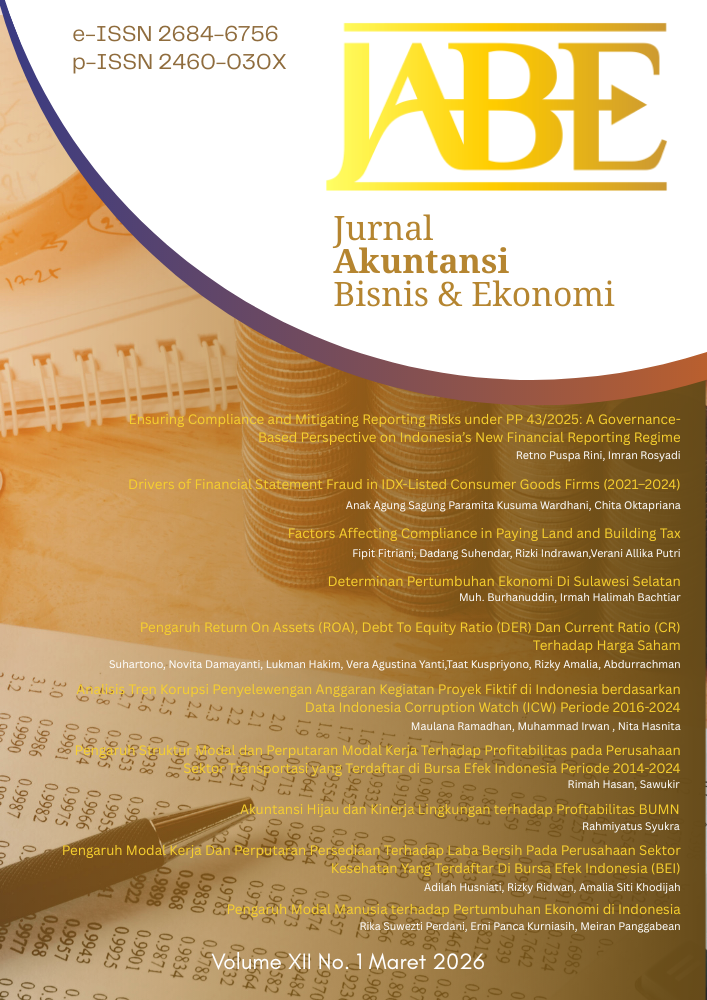
Ensuring Compliance and Mitigating Reporting Risks under PP 43/2025: A Governance-Based Perspective on Indonesia’s New Financial Reporting Regime
DOI:
https://doi.org/10.33197/jabe.vol12.iss1.2026.3486Keywords:
Financial Reporting Governance, Regulatory Compliance, PP 43/2025, Internal Control, Digital Reporting SystemsAbstract
This study examines Indonesia’s Government Regulation No. 43 of 2025 (PP 43/2025), a major reform that restructures national financial reporting obligations by mandating standardized financial statements, digital submission through the Platform Bersama Pelaporan Keuangan (PBPK), competency and integrity requirements for preparers, and formal management responsibility for reporting accuracy. Positioned within governance theory, compliance scholarship, digital financial reporting research, and COSO’s internal control framework, this study employs a qualitative exploratory approach and regulatory mapping to analyse the implications of PP 43/2025 from the perspective of financial statement preparers. The findings demonstrate that PP 43/2025 substantially elevates accountability and transparency through centralized, real‑time, and multi‑agency access to financial statements; however, it simultaneously intensifies compliance pressure and creates new categories of reporting risk—including misstatement risk, governance liability, technological vulnerability, and human‑capital constraints. PBPK’s role as the single authoritative reporting channel increases the visibility and durability of errors, making robust internal controls and governance oversight essential prerequisites for compliance. The study proposes a governance‑based reporting framework that integrates regulatory obligations, COSO‑aligned control mechanisms, and organisational governance structures to mitigate preparer‑side risks. Conceptually, the research advances understanding of how digital regulatory infrastructures reshape financial reporting governance in emerging markets. Practically, it offers preparers, auditors, and regulators a structured foundation for strengthening reporting readiness and internal governance capabilities under the new regulatory regime
Downloads
References
Aguilera, R. V., & Jackson, G. (2003). The cross-national diversity of corporate governance: Dimensions and determinants. Academy of Management Review, 28(3), 447–465.
Al-Dmour, A., Abbod, M., & Al-Dmour, H. (2017). The impact of the quality of financial reporting on non-financial business performance and the role of organizations’ demographic characteristics. International Journal of Business and Management, 12(6), 1–18.
Alles, M., & Gray, G. L. (2020). The digital transformation of accounting and auditing. International Journal of Accounting Information Systems, 36, 100438. https://doi.org/10.1016/j.accinf.2020.100438
Ayres, I., & Braithwaite, J. (1992). Responsive regulation: Transcending the deregulation debate. Oxford University Press.
Baldwin, R., Cave, M., & Lodge, M. (2012). Understanding regulation: Theory, strategy, and practice (2nd ed.). Oxford University Press.
Bananuka, J., Nkundabanyanga, S. K., Nalukenge, I., & Kaawaase, T. K. (2019). Internal audit function, audit committee effectiveness and accountability in public sector organizations. Journal of Accounting in Emerging Economies, 9(3), 420–444.
Beest, F. van, Braam, G., & Boelens, S. (2009). Quality of financial reporting: Measuring qualitative characteristics. Nijmegen Center for Economics (NiCE) Working Paper, 09-108.
Bushman, R. M., & Smith, A. J. (2001). Financial accounting information and corporate governance. Journal of Accounting and Economics, 32(1–3), 237–333.
Committee of Sponsoring Organizations of the Treadway Commission. (2013). Internal control—Integrated framework. COSO.
Committee of Sponsoring Organizations of the Treadway Commission. (2015). Internal control over external financial reporting: A compendium of approaches and examples. COSO.
Committee of Sponsoring Organizations of the Treadway Commission. (2017). Enterprise risk management—Integrating with strategy and performance. COSO.
Debreceny, R., Farewell, S., Piechocki, M., Felden, C., & Gräning, A. (2010). Does it matter who uses XBRL? Evidence from SEC filings. Journal of Information Systems, 24(2), 1–22.
Dechow, P. M., Ge, W., & Schrand, C. (2010). Understanding earnings quality: A review of the proxies, their determinants, and their consequences. Journal of Accounting and Economics, 50(2–3), 344–401.
Diamond, J. (2002). Performance budgeting: Managing the reform process. IMF Working Paper, WP/02/12. https://doi.org/10.5089/9781451843900.001
Government Regulation of the Republic of Indonesia Number 43 of 2025 on financial reporting (PP 43/2025). (2025). Lembaran Negara Republik Indonesia, 155 (Year 2025).
Healy, P. M., & Palepu, K. G. (2001). Information asymmetry, corporate disclosure, and the capital markets: A review of the empirical disclosure literature. Journal of Accounting and Economics, 31(1–3), 405–440.
Hermanson, D. R., & Rittenberg, L. E. (2003). Internal audit and organizational governance. Institute of Internal Auditors Research Foundation.
Ikatan Akuntan Indonesia. (2022). Standar akuntansi keuangan. Salemba Empat.
Knechel, W. R., & Salterio, S. E. (2016). Auditing: Assurance and risk (4th ed.). Routledge.
Law of the Republic of Indonesia Number 4 of 2023 on development and strengthening of the financial sector. (2023).
Moll, J., & Yigitbasioglu, O. (2019). The role of internet-related technologies in shaping the work of accountants: New directions for accounting research. British Accounting Review, 51(6), 100833.
OECD. (2015). G20/OECD principles of corporate governance. OECD Publishing.
Otoritas Jasa Keuangan. (2023). Financial reporting and governance guidelines. Otoritas Jasa Keuangan.
Parker, C., & Nielsen, V. L. (2011). Explaining compliance: Business responses to regulation. Edward Elgar Publishing.
Pina, V., Torres, L., & Royo, S. (2007). Are ICTs improving transparency and accountability in the EU regional and local governments? Public Administration, 85(2), 449–472.
Shleifer, A., & Vishny, R. W. (1997). A survey of corporate governance. The Journal of Finance, 52(2), 737–783.
Spira, L. F., & Page, M. (2003). Risk management: The reinvention of internal control and the changing role of internal audit. Accounting, Auditing & Accountability Journal, 16(4), 640–661.
Troshani, I, Parker, L. D., & Lymer, A. (2015). Institutionalising XBRL for financial reporting: Resorting to regulation. Accounting and Business Research, 45(2), 196–228.
Downloads
Published
How to Cite
Issue
Section
License
Copyright (c) 2026 Jurnal Akuntansi Bisnis dan Ekonomi

This work is licensed under a Creative Commons Attribution-NonCommercial-ShareAlike 4.0 International License.
Submission of a manuscript implies that the submitted work has not been published before (except as part of a thesis or report, or abstract); that it is not under consideration for publication elsewhere; that its publication has been approved by all co-authors. If and when the manuscript is accepted for publication, the author(s) still hold the copyright and retain publishing rights without restrictions. Authors or others are allowed to multiply the article as long as not for commercial purposes. For the new invention, authors are suggested to manage its patent before published. The license type is CC-BY-SA 4.0.