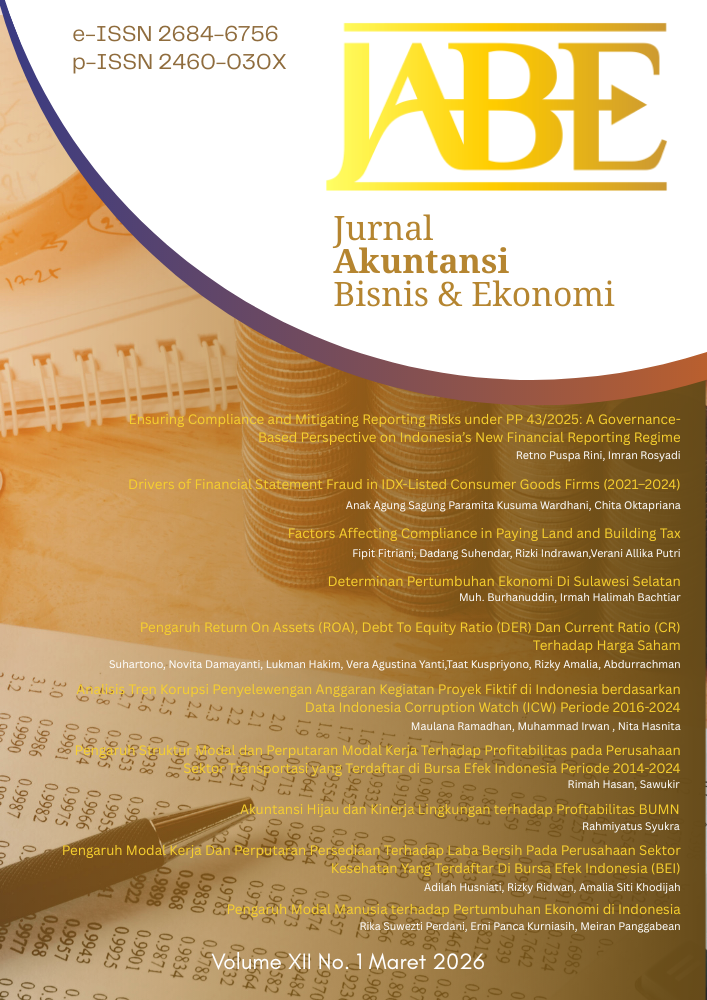
The Influence of Return on Assets (ROA), Debt to Equity Ratio (DER) and Current Ratio (CR) on Stock Prices
DOI:
https://doi.org/10.33197/jabe.vol12.iss1.2026.3218Keywords:
Return On Assets (ROA), Debt To Equity Ratio, Current Ratio, Harga SahamAbstract
The capital market is a meeting place for parties with excess funds and those requiring additional capital, both for the short and long term. Profits are calculated by considering the sales yield per share. The stock price itself is the value or price of a share traded on the stock market. This study aims to determine the effect of variables such as Return on Assets, Debt to Equity Ratio, and Current Ratio on stock prices listed on the Indonesia Stock Exchange. This study used a quantitative approach with multiple linear regression using SPSS version 27. The sample was taken using a purposive sampling technique, with 11 companies. The results showed that simultaneously, the variables ROA, DER, and CR had a significant positive effect on stock prices, as indicated by the calculated F value of 12.101, which is greater than the F table of 2.839, with a significance level of 0.001, which is below the 0.05 limit. Partially, only the CR variable had a significant positive effect on stock prices, with a calculated t value of 5.389 and a significance level of 0.001. Meanwhile, the ROA and DER variables did not show a significant effect, with significance levels of 0.383 and 0.393, respectively, exceeding the 0.05 threshold.
Keywords: ROA, DER, CR, Stock Price
Downloads
Downloads
Published
How to Cite
Issue
Section
License
Copyright (c) 2026 Jurnal Akuntansi Bisnis dan Ekonomi

This work is licensed under a Creative Commons Attribution-NonCommercial-ShareAlike 4.0 International License.
Submission of a manuscript implies that the submitted work has not been published before (except as part of a thesis or report, or abstract); that it is not under consideration for publication elsewhere; that its publication has been approved by all co-authors. If and when the manuscript is accepted for publication, the author(s) still hold the copyright and retain publishing rights without restrictions. Authors or others are allowed to multiply the article as long as not for commercial purposes. For the new invention, authors are suggested to manage its patent before published. The license type is CC-BY-SA 4.0.