
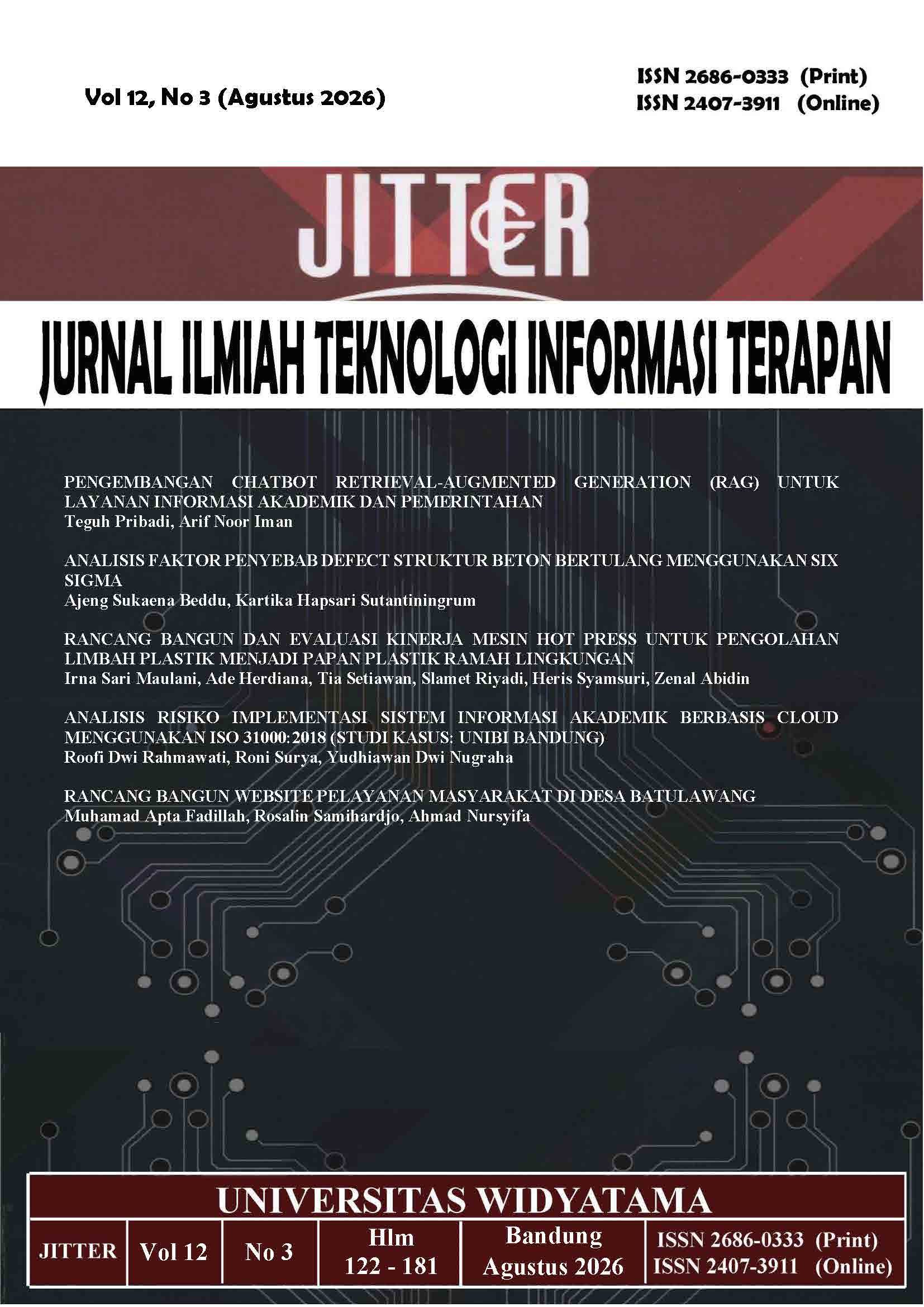
ANALYSIS OF FACTORS CAUSING DEFECTS IN REINFORCED CONCRETE STRUCTURES USING SIX SIGMA
DOI:
https://doi.org/10.33197/jitter.vol12.iss3.2026.3695Keywords:
Defects, DMAIC, Quality Control, Reinforced Concrete Structure, Six SigmaAbstract
Reinforced concrete structural work is a critical component of building construction that must meet quality standards to ensure structural safety and performance. However, various defects are still frequently encountered during construction, reducing work quality and requiring corrective actions. This study aims to identify the dominant defects, evaluate process capability using the Six Sigma method, analyze the dominant factors causing defects, and propose improvement strategies to enhance the quality of reinforced concrete structural work. This study employed a quantitative descriptive method using the Define, Measure, Analyze, Improve, and Control (DMAIC) approach. Data were collected through Non-Conformance Reports (NCR), field observations, questionnaires, and interviews conducted in Office Building Project X, Central Jakarta. The Measure phase involved calculating the Defect per Million Opportunities (DPMO) and sigma level, while the Analyze phase employed fishbone diagrams and mean analysis to identify the dominant causal factors. The results revealed that honeycombing was the most dominant defect, accounting for 48.78% of column defects, 43.54% of slab defects, and 40.00% of structural wall defects. The sigma levels for columns, slabs, and structural walls were 2.76, 2.90, and 2.67, respectively, indicating that the process capability remains at an average industrial level and requires further quality improvement. Human resources were identified as the dominant factor contributing to defects, with a mean value of 12.83, while worker inaccuracy and lack of discipline were the most influential indicators, with a mean value of 3.375. Based on these findings, improvements are recommended through enhanced supervision, worker guidance, stricter implementation of work procedures, and continuous quality control to minimize defects in reinforced concrete structural work.
Downloads
Downloads
Published
How to Cite
Issue
Section
License
Copyright (c) 2026 Kartika Hapsari, Ajeng Sukaena Beddu

This work is licensed under a Creative Commons Attribution-NonCommercial-ShareAlike 4.0 International License.
Submission of a manuscript implies that the submitted work has not been published before (except as part of a thesis or report, or abstract); that it is not under consideration for publication elsewhere; that its publication has been approved by all co-authors. If and when the manuscript is accepted for publication, the author(s) still hold the copyright and retain publishing rights without restrictions. Authors or others are allowed to multiply the article as long as not for commercial purposes. For the new invention, authors are suggested to manage its patent before published. The license type is CC-BY-SA 4.0.















.png)


.png)